
Feedback and Feedforward
Have you thought about the difference between feedback and feedforward? How do we use the two effectively? A journey through cybernetics and non-violent communication.

This article explores the distinction between feedback and feedforward, and how they can be applied to improve collaboration and communication in human systems.
I also explore the role of safety in a sound feedback culture, and take a look at Non-Violent Communication (NVC) as a way to combine the two in an effective communication style.
Finally, some suggestions for how to integrate concepts from NVC into your everyday communication and become more aware of how you can give and leverage feedback and feedforward in it.

Cybernetics
The terms feedback and feedforward originate from Systems Theory. There they're used to describe how a system interacts with its environment and I think this makes a useful way of thinking to how the concepts work in human systems. Any system that continously gathers feedback and feedforward, and adjusts it's behaviour based on this, can be thought of as a cybernetic unit. Conceptually, they consist of three components that perform three distinct functions1.
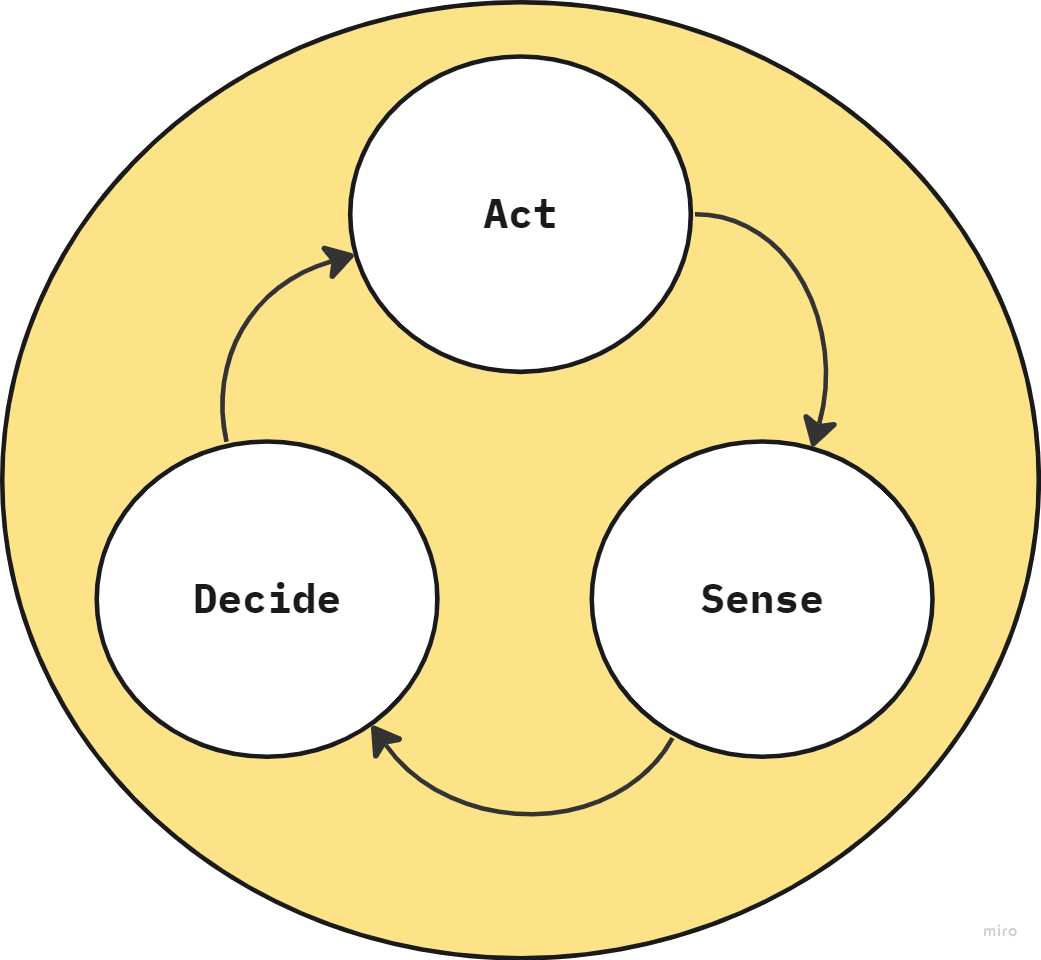
A sensor that perceives the environment;
A controller that takes decisions based on some internal logic and input from the sensor; and
an actuator some function or feature that interacts with the environment based on input from the controller.
Information flows continuously through these components in what’s called a cybernetic loop.
A thermostat is a classical example of this. It has a thermometer that can tell the temperature of the room (the sensor), a little computer (the controller) that controls a heater (the actuator) based on input from the thermometer to maintain room temperature.
All models are wrong. Some are useful.
— George Box
The cybernetic unit can serve as a useful mental model for some of our internal processes. We observe, decide, and interact with the world through our actions. It should be said humans are more complex than thermostats because we also feel, think and live in a rich sociocultural context that this model simply doesn’t capture. Let's see how we can use the model to think about feedback and feedforward!
Feedback & Feedforward
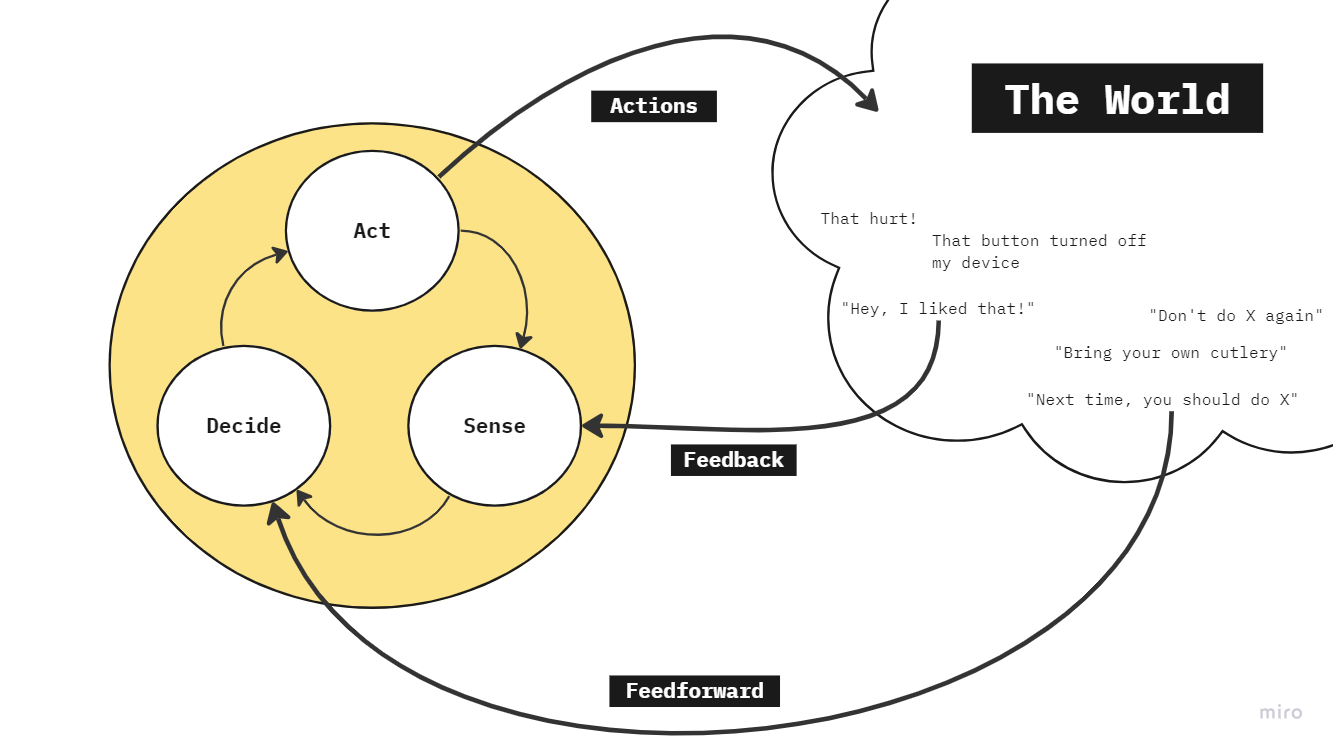
Feedback is the data that we get back from what happened in the world as a result of our actions. Some of that we can perceive with our senses, some with tools and measurements. Other feedback is locked away inside people unless they choose share it - things like emotional reactions and thoughts.
What makes the people around you different from most other cybernetic units is the fact that they reflect, learn and experience emotions as they go through their own loops.
This human experience also gives rise to opinions and ideas about how you should or shouldn't be doing things. Or things you should or shouldn't be doing. These ideas can be expressed more or less constructively, and sometimes they sound like advice.
There is a subtle difference to these things from feedback. Some of the things we hear from people are input to your “controller”, your decision-making function. They're designed to affect your future decisions. This is feedforward.
Generally speaking, feedforward aims to adjust actions based on anticipated future outcomes, like a vision, fears or an ideal2. Essentially, it works toward making a desired future more probable.
Let's look at some examples to clarify the difference:
Feedback
That was a fun workshop!
I don't understand what that means
These whiteboard pens don't work
That is disappointing to hear
Feedforward
We should do this every week!
Try to structure your meeting better
You should smile more
Stop doing those check-ins
Like the names suggest, feedback is retrospective — focusing on the past. It always comes after the fact, reflecting on what has already occurred. In contrast, feedforward is prospective —oriented towards the future. It comes ahead of time, in anticipation of what is yet to happen.
When it comes to this kind of communication, it's not the case that one is simply better than the other, but I find that understanding both feedback and feedforward — as well as their interplay — helps me use them more effectively. Sometimes it’s better to offer one or the other, and sometimes it’s best to give both.
Safety
Given that we know all this, the question remains: why do we so often struggle with feedback and feedforward? I believe the crux of the matter is that there is a lot of social risk involved in this kind of communication — it’s a vulnerable experience to be on either side of it. As the communicator, it can be hard to know how how the other part reacts to unfavourable feedback. As the recipient, feedback and feedforward can trigger all manner of insecurities. This means that psychological safety is a crucial component in effectively giving and receiving feedback or feedforward.
Getting only feedback by itself can feel unactionable to the recipient, or sometimes as if there is some implied advice (feedforward) in it. This can feel unsafe - as if there are some hidden expectations on you. On the other hand relying more on feedback can be useful if you want to avoid being perceived as giving unwanted advice, opening up the conversation to a space where feedforward can more safely be given or requested. The context and method of communication makes all the difference here. Consider the difference between hearing:
“I didn’t feel like I could participate during the last retrospective.”
“I didn’t feel like I could participate during the last retrospective. Do you think we can do something differently next time?”
“I didn’t feel like I could participate during the last retrospective, maybe you can try a round-robin style discussion next time?”
These three statements all contain the same feedback - a participant’s experience of a retrospective - but they have different kinds of feedforward.
Feedforward communicates a wish or expectation of the communicator for how they wish that the person would act differently in the future. Remember, this wish pertains to some desired future — but what if the parties aren't aligned about this future? Have you ever gotten advice that would take you in a difference direction than you want to go?
While feedforward by itself is certainly much more action-oriented, it can seem harsher, aloof or inconsiderate. Consider the difference between these:
“I wish you would take more notes of our meetings.”
“I don’t know what you’ve been up to last week. I wish you would take more notes of our meetings.“
“I’m feeling stressed because I don’t know what’s happened while I’ve been away. I wish you would take more notes of our meetings.”
These three statements contains the same feedforward but are coupled with different kinds of feedback. Can you see how they could elicit very different kinds of emotional responses?
Non-violent Communication
Moving into another aspect of communication, Non-violent Communication (NVC) developed by Marshall Rosenberg, offers a comprehensive communication approach for fostering connection and understanding3.
One of the many useful things from NVC is a format for communication known as OFNR. It's especially useful for communicating when there is some kind of conflict, or a need isn't being met but shouldn’t be limited to such situations. It stands for Observation, Feeling, Need and Request which is simply a description of the format.
Observation: Describing specific, observable behaviors or actions without interpretation or judgment.
Feeling: Expressing emotions triggered by the observed behavior.
Need: Identifying the underlying universal human need or value connected to the feelings expressed.
Request: Making a clear and actionable request related to the need expressed.
Let's take a look at a couple of examples:
“During our last meeting you interrupted me several times. It made me feel sad and frustrated. I need to feel heard and that I am included to participate on the same terms as everyone else. Can you let me finish next time before you speak?”
or
“When you invited me to speak at your course I felt happy and honoured. Recognition and the opportunity to share my knowledge are important to my personal and professional growth. If you have any opportunities to collaborate in the future, please let me know!“
The reason OFNR is so effective is because of how it combines feeback — in the Observation and Feeling — and feedforward — Need and Request. By combining the two in the message, the recipient can understand and connect with the communicator.
NVC is also useful when you are the recipient of the communication. If you can open up to connect and understand a person giving you feedback or feedforward you will have much richer interactions. Whenever someone communicates with you, particularly in a way that gives you a negative emotional reaction, ask yourself:
“Do I understand what feelings and needs are coming through here”?
“What assumptions are we both making about each other now?”
When you're listening, especially in a less structured communication setting, use specific questions to guide the speaker towards providing information in an OFNR format. This helps you gain a clear understanding of their message.
Observation: Encourage the speaker to specify the situation or behavior they are referring to.
"Can you describe the specific situation or action you're referring to?"
"What exactly did you observe that prompted this discussion?"
Feeling: Ask questions to understand the emotions involved in the speaker's message.
"How did that make you feel?"
"What emotions are you experiencing regarding this?"
Need: Probe to uncover the underlying needs or values related to their feelings.
"What need or value is important to you in this situation?"
"What do you feel is missing or needed here?"
Request: Clarify any actions or changes the speaker desires.
"What would you like to see happen next?"
"Is there a specific request or change you’re proposing?"
By actively guiding the conversation with these questions, you can help the speaker articulate their thoughts in a structured manner. This not only clarifies their message but also fosters a deeper understanding and connection in the communication process.
Conclusion
Everyday communication is ripe with opportunities to improve the way you understand and use feedback and feedforward. You can use OFNR as a basis to both improve your own communication and your listening:
Observation: Try using neutral observations for describing events or behaviors without adding personal interpretations or judgments.
Example: "You're always late to meetings" vs "I noticed you arrived 15 minutes late to the meeting."
Feelings: Express your feelings instead of making assumptions of others' intentions and without assigning their cause to someone else's actions.
Example: "He's sabotaging my project!" vs "I feel concerned and unsupported when my project updates are not acknowledged.”
Needs: Be clear about what you need and what is important to you instead of assigning blame for situations you're not comfortable in.
Example: "You never listen to me" vs "I need to feel heard and understood in our discussions.
Requests: Make concrete requests rather than demands or vague suggestions.
Example: "You should know what I need" vs "Could you please check in with me once a week to discuss project progress?"
It can be hard or awkward to start using these concepts straight away, so another suggestion is to use the same concepts to observe how others around you communicate with you or each other:
Notice the Dynamics: Pay attention to how others interact. Are they using evaluations or observations? Do they express their feelings clearly or make assumptions about others?
Reflect on Potential: Consider how different interactions could be if OFNR principles were applied. Which conversations might have been more constructive or less confrontational?
Learn from Observation: Use these observations as a learning tool. How could you apply these insights to your own communication style?
Ask yourself: Which interactions could have been transformed if the communication would have been different? This reflection not only helps you understand the power of NVC but also prepares you to integrate these principles more seamlessly into your own communication.
Thanks for reading my first published article! I want your feedback and feedforward: let me know if you found this informative, useful or entertaining - and if there is anything here you would like me to dive deeper into. Either in writing or over digital coffee!
In all but very simple examples, these functions are distributed in the unit. Humans, to take an example, have a variety of ways to percieve their environment including vision, hearing, sense, taste and smell. Some would argue that human cognition is a distributed function. We can influence our environment physically through our bodies and verbally through language. Needless to say, the inner workings of how information and causality flows between them is more complex than should be attempted to portray in a simple diagram.
In electronic control systems, feedforward requires some kind of mathematical model. In humans, this corresponds to their beliefs, values and fears about the world. We tend to like when people act in a way that aligns with those. Of course, there are cases where the feedforward you offer pertains more to helping a person to act on their own beliefs, values and fears — for instance in coaching or therapy.
It emphasizes empathetic listening, authentic communication of feelings and needs, non-judgemental communication, conflict resolution and the recognition of universal human needs as basis for understanding behaviour and conflict.